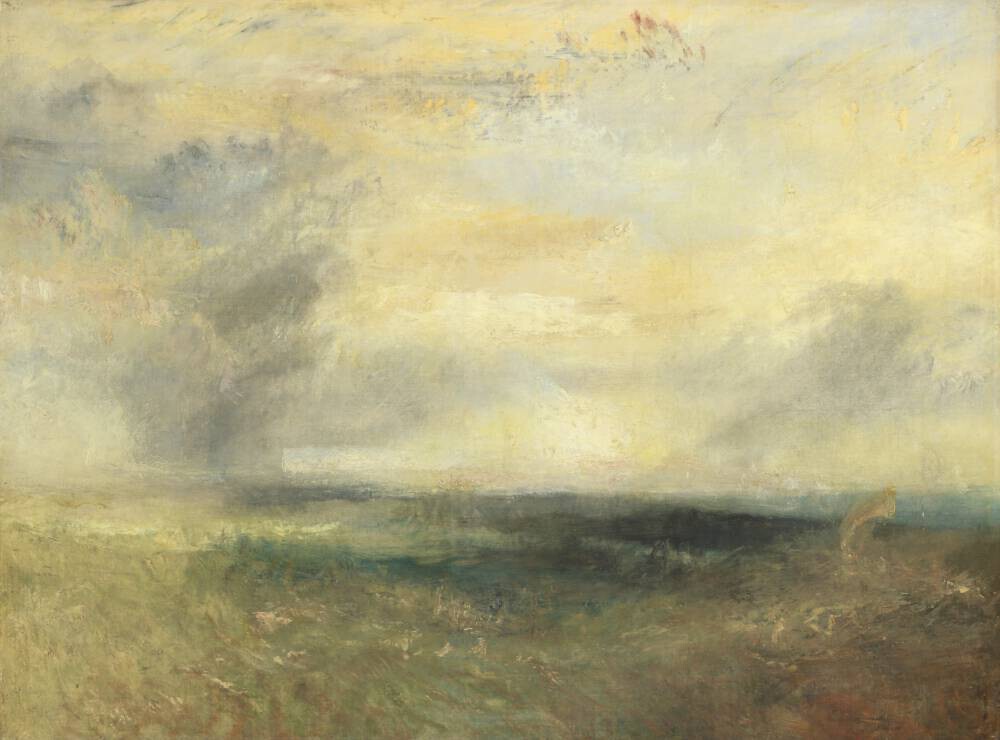


One of our greatest painters, Turner’s sublime works always fascinate. Amongst his many masterpieces, Dido Building Carthage was Turner’s own favourite. We asked our friends at The National Gallery to share a little insight into this remarkable painting:
“Joseph Mallord William Turner, son of a modest barber in Covent Garden, yearned for sublimity. Trained as a topographical draughtsman, Turner achieved his ambition through mastering the idioms of the 17th-century French painter Claude and of Dutch 17th-century marine and landscape painters.
Dido Building Carthage is one of Turner’s most ambitious imitations of Claude. The subject, inspired by Virgil’s epic Latin poem, the ‘Aeneid’, is the building of the North African city of Carthage, which Dido founded. The figure in white on the left is Dido, and on the right is the tomb erected for her dead husband, Sichaeus. In front of Dido is a figure who may be Aeneas: Virgil tells of their love affair, and of Dido’s suicide following his departure. Turner was attracted by the human contrast to the theme of empire building. Hints of doom contrast with the serene effects of sunlight.
Turner considered Dido Building Carthage to be his masterpiece and in his will Turner asked that the painting hang between Claude’s Seaport and the Embarkation of the Queen of Sheba and The Mill. The composition and mood of the painting were intended as a conscious homage to the work of Claude, which Turner deeply admired. Turner’s bequest has been honoured and the three paintings can be found together in Room 15 of The National Gallery.”
Name Joseph Mallord William Turner
Collection National Gallery
Category Galleries & Museums
Date 1789 – 1862